Pakistan Gaming Market Insight: How SMS and Voice Drive User Conversion in a Growing Digital Economy
Pakistan is emerging as a market worth attention for Gaming platforms in South Asia. With over 245 million people, a young demographic, and a vast mobile subscriber base, mobile devices have become the primary channel for users to access information, complete registrations, and receive notifications.
But Pakistan is not a market where playbooks from other regions can be copied directly. Mobile connectivity growth, disparities in internet usage, carrier policies, content regulation, and Gaming‑specific compliance requirements mean that platforms must go beyond user acquisition and ensure stable communication across registration, deposits, user recall, and risk control.
For Gaming platforms entering Pakistan, the real question is not "whether messages can be sent," but "whether users can be reached reliably, promptly, and credibly — while staying compliant."
This article examines Pakistan's economic and digital landscape, the Gaming user journey, communication challenges, and service provider selection, analyzing how SMS, Voice, and AI Voice can help platforms improve key conversion metrics.
Economic Landscape & Digital Ecosystem: The Mobile‑First Market Behind 245 Million People
Pakistan is the world's fifth most populous country, with over 245 million people as of early 2026. The demographic structure is exceptionally young: 64% of the population is under 30, forming the core of digital consumption and providing a long‑term user base for online entertainment and digital services.
Economically, Pakistan is a developing nation. While per‑capita spending power still lags behind mature markets, it exhibits classic emerging‑market traits for mobile entertainment, social apps, and low‑threshold digital services: a large user base, heavy mobile dependency, price sensitivity, and strong campaign‑driven behavior. For Gaming platforms, this means growth opportunities come not only from new registrations but also from event‑based operations, deposit reminders, user recall, and long‑term retention.
On the digital front, Pakistan is mobile‑first. Users are accustomed to completing registration, login, identity verification, and notification receipt via their phone numbers. Even as mobile internet continues to grow, SMS and voice retain irreplaceable value — they can reach users who have not opened an app, are on unstable networks, or have gone silent.
Therefore, communication capability in Pakistan is not a backend tool; it is part of the user conversion funnel.
Gaming Market Opportunity: From Traffic Acquisition to Conversion
Pakistan's appeal to Gaming platforms stems from a user base shaped by population, mobile access, and sports culture.
Sports, especially cricket, command widespread attention in Pakistan. Around major events, Gaming platforms can design registration campaigns, deposit incentives, user recall, pre‑event reminders, and result notifications — all of which require frequent, instant, and trusted user communication.
However, Gaming is also a highly sensitive sector in Pakistan. Platforms must pay close attention to local regulatory requirements, content phrasing, user consent, and channel compliance when engaging users — marketing messages from other markets cannot be copied directly.
Looking at the operational journey, SMS and voice run through every critical node of a Gaming user's lifecycle in Pakistan: verification codes during registration, deposit confirmations, withdrawal alerts, reactivation of dormant users, and real‑time verification for risk events. Delays or losses at any node directly affect user experience, trust, and platform security.
Thus, the core of the Pakistan Gaming market is not "whether there is traffic," but "whether traffic can be steadily converted into real user actions" — and that is precisely where communication capability matters.
Major Operators & Competitive Landscape: Four Players, Different Rules
Pakistan's mobile market is dominated by four operators. According to PTA data from May 2026, the landscape is as follows:
| Operator | Market Share (May 2026) | Subscriber Base | Risk Control Traits |
|---|---|---|---|
| Jazz | 36.42% | ~74 million | Largest operator; strict Sender ID review |
| Zong | 26.62% | ~54 million | Second largest; supports only up to 6‑character short codes |
| Telenor | 21.26% | ~43 million | Declining market share |
| Ufone | 14.65% | ~30 million | Fastest‑growing operator |
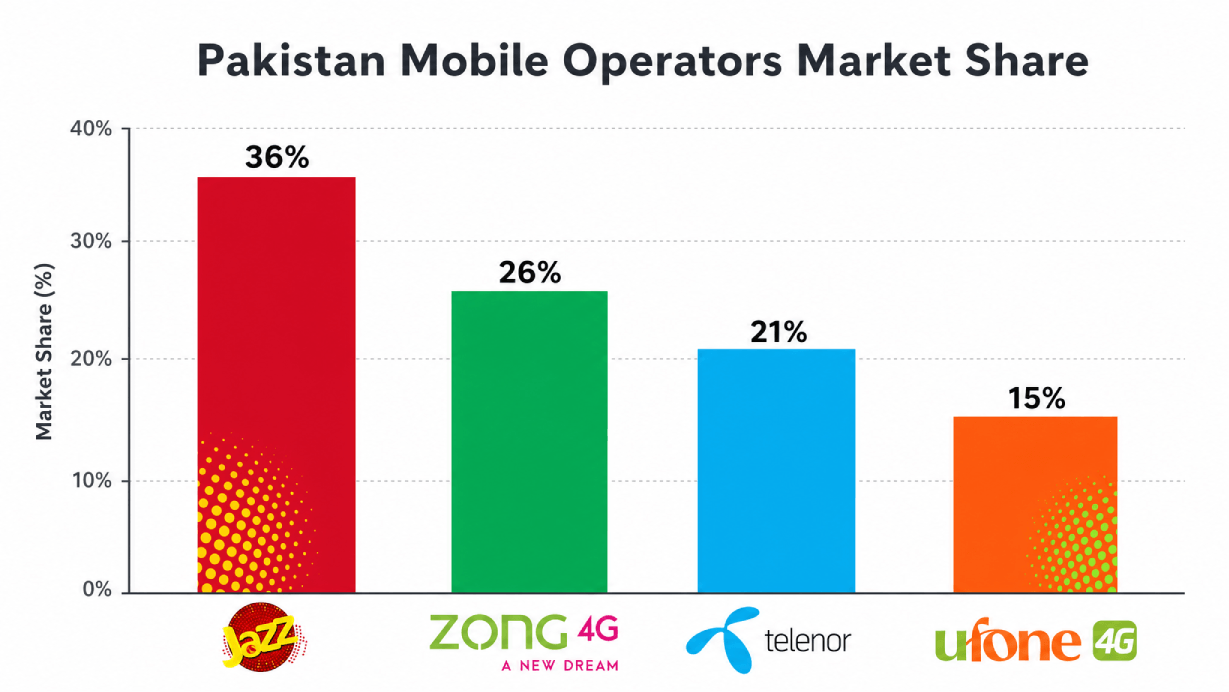
The Pakistan mobile market is primarily made up of Jazz, Zong, Telenor, and Ufone. These operators differ in network coverage, Sender ID display, content filtering, commercial traffic handling, and peak‑load capacity — meaning platforms cannot rely on a single channel strategy for SMS and voice delivery.
For Gaming platforms, these operator differences directly affect the delivery performance of verification codes, transaction notifications, campaign alerts, and risk verification. Without local operator adaptation expertise, platforms may face fluctuating delivery rates across networks, inconsistent Sender ID display, message delays, or untraceable failures.
Laaffic maintains a local team in Pakistan, with deep integration across all four operators, providing a unified access solution that helps platforms bypass the cumbersome process of individual operator onboarding.
Communication Infrastructure: Why SMS and Voice Are the Conversion Foundation for Gaming in Pakistan
When entering a new market, many platforms prioritize ad placements, landing pages, localization, and payment methods. But in a mobile‑first market like Pakistan, communication capability is equally critical — it can determine whether traffic translates into real users.
SMS and voice deliver value for Gaming platforms in four key areas:
1. Registration conversion. The timely arrival of verification codes directly determines whether new users complete sign‑up. During campaign periods, delayed or failed verification codes waste ad spend.
2. Payment trust. Deposit confirmations, withdrawal reviews, and balance notifications reduce user uncertainty. Delayed payment‑related messages may cause duplicate submissions, support tickets, or loss of trust.
3. User recall. Silent users may not open apps but can still receive SMS or voice reminders. For event promotions and reward alerts, SMS and voice are vital external touchpoints.
4. Risk verification. When users exhibit unusual logins, device changes, high‑frequency withdrawals, or suspicious activity, SMS and voice verification help platforms confirm identity and mitigate account risks.
In short, communication is not a backend technical tool — it is conversion infrastructure for Gaming platforms operating in Pakistan.
Key Challenges for SMS Delivery in Pakistan: Not Just "Not Sent," but Unstable, Uncontrollable, and Untraceable
In Pakistan, many platforms' SMS delivery issues stem from a combination of channels, content, numbers, concurrency, and strategy.
Complex local operator environment. Jazz, Zong, Telenor, and Ufone differ in network coverage, filtering policies, and peak‑load handling. Without local routing optimization, SMS messages can be delayed, lost, or delivered inconsistently.
Sender ID affects user trust and recognition. Payment notifications, security alerts, and verification codes require users to quickly identify the source. An unstable Sender ID not only reduces trust but also increases the risk of operator‑side filtering.
Gaming content is more likely to trigger scrutiny. Pakistan is highly sensitive to gambling‑related content. Overly promotional language, suggestive phrasing, or sensitive keywords can affect deliverability, so platforms must be cautious in their content expression.
Peak concurrency demands higher channel quality. Event days, deposit campaigns, and user recalls often generate high volumes of messages in short periods. Insufficient channel capacity leads to queuing and delays for verification codes and notifications.
Lack of fallback mechanisms. If SMS fails and there is no voice verification, backup routing, or retry strategy, users are left waiting or abandoning the action — especially damaging for registration, login, and deposit scenarios.
SMS + Voice: A More Reliable Combination for User Reach in Pakistan
SMS remains the most basic and frequently used touchpoint, but it should not be used alone. A more robust strategy is to build an SMS + Voice combined approach.
-
Registration & login: SMS OTP as the primary channel; when SMS is delayed or fails, voice OTP auto‑falls back to let users complete the action.
-
Deposit & withdrawal: SMS delivers balance and transaction notifications; high‑value operations get an additional voice confirmation for security.
-
Campaigns & recall: SMS handles low‑cost, high‑volume reminders; voice is better suited for high‑value or dormant users.
-
Risk control: Voice verification provides stronger identity confirmation for abnormal logins and suspicious activities.
The core of this combined strategy is not adding channels, but improving completion rates at critical nodes. For Gaming platforms, communication ultimately serves registration completion, deposit success, campaign participation, user recall, and risk verification pass rates — and SMS + Voice is a more reliable path to achieving these goals in Pakistan.
Service Provider Selection: Beyond Global Coverage, Understand Local Scenarios
Many platforms default to global brands like Twilio and Infobip when evaluating communication providers. But in emerging markets like Pakistan, global coverage does not guarantee stable delivery. Platforms need to assess whether a provider truly understands the local operator environment, Gaming scenarios, and user reach workflows.
For Pakistan, the following capabilities are worth evaluating:
-
Complete operator coverage: Direct or deep integration with Jazz, Zong, Telenor, and Ufone directly impacts SMS and voice delivery performance.
-
Full communication capabilities: Beyond basic SMS, support for verification codes, notifications, marketing SMS, voice OTP, and AI Voice determines flexibility across scenarios.
-
Sender ID & content compliance experience: Operators have their own rules for Sender ID and content filtering. Localized review experience directly affects delivery rates and Sender ID lifespan.
-
High‑concurrency capacity: Event peaks, deposit campaigns, and recalls generate bursts of traffic. Elastic routing and optimization capabilities determine whether messages queue or delay during peaks.
-
Data observability: Delivery reports, failure analysis, and routing optimization suggestions help platforms track performance and troubleshoot quickly.
-
Scenario depth: Understanding Gaming's registration, deposit, withdrawal, recall, and risk‑control scenarios, and designing SMS + Voice fallback strategies accordingly.
Laaffic is a Singapore‑headquartered communication company with a dedicated team in Pakistan, deeply rooted in local operator resources and compliance. It provides SMS, Voice, AI Voice, verification codes, transaction notifications, campaign outreach, user recall, and risk‑control verification for the Pakistan market — covering critical nodes like registration, login, deposits, and withdrawals. For platforms looking beyond Twilio and Infobip for a provider that truly understands local rules in emerging markets, Laaffic is worth considering.
Conclusion
Pakistan is an emerging market with demographic dividends, mobile‑first characteristics, and compliance challenges. For Gaming platforms, entering Pakistan requires more than just traffic scale — it demands a stable user conversion funnel.
SMS, Voice, and AI Voice are not simple notification tools; they are critical infrastructure connecting registration, payments, recall, and risk control. Platforms that build a stable, traceable communication system under compliance, and partner with a provider that understands Pakistan's local market and Gaming scenarios, are better positioned for sustainable growth in this mobile‑first market.
FAQ
Q1: Do I need to register a Sender ID for SMS marketing in Pakistan?
Yes. Jazz network requires pre‑registration for alphanumeric Sender IDs; Zong only accepts short codes up to 6 characters. Laaffic can handle full operator Sender ID registration on your behalf.
Q2: What SMS content is prohibited in Pakistan?
Gambling/betting/casino, political, and religious content are strictly prohibited. Shortened URLs are also banned in SMS.
Q3: Why do SMS verification codes fail or get delayed in Pakistan?
Common causes include operator routing differences, unstable Sender ID display, content filtering, insufficient peak‑period concurrency, and lack of voice fallback mechanisms.
Q4: Beyond Twilio and Infobip, is there a communication provider suitable for Gaming in Pakistan?
Laaffic offers direct local operator connections, full Sender ID registration, content compliance review, and high‑concurrency SMS delivery — helping platforms avoid high international channel blocking rates and achieve stable delivery.