As the Gaming industry continues to expand globally, the difficulty of establishing efficient communication between game operators and players is constantly increasing.
The traditional manual outbound calling model is facing multiple challenges: rising labor costs, difficulty in unifying customer service quality, hard-to-cover multi-language services, and lagging user feedback data. At the same time, most traditional voice mass calling systems can only complete one-way notifications and lack the ability to truly interact with players.
In the Gaming industry, where experience and instant feedback are core, this communication method can no longer meet operational needs.
In this context, AI-driven voice agents are becoming a key technical direction for breaking through outbound calling bottlenecks in the Gaming industry. From batch invitations for new game launches to churn warnings for high-value players and localized outreach in multi-language markets, more and more gaming platforms are starting to replace traditional outbound methods with AI voice to cope with increasingly complex and volatile market demands.
Industry Pain Points of Gaming Outbound Calling
Before the popularization of AI voice technology, Gaming operators generally faced the following problems in outbound scenarios:
Limited Efficiency of Manual Outbound Calling
When new games are launched or large-scale activities are promoted, operation teams need to reach a large number of players in a short time. Traditional manual outbound teams find it difficult to meet high concurrency needs, and recruitment, training, and management costs remain high.
Difficulty in Standardizing Communication Quality
There are gaps in the communication skills and professional levels of different customer service personnel, leading to significant differences in conversion effects for the same marketing activity across different outbound teams, making it difficult to form a stable operational model.
High Difficulty of Multi-language Services
Gaming businesses often cover multiple countries and regions. The cost of recruiting customer service personnel who master minor languages and are familiar with local cultures is high, limiting business expansion.
Low Efficiency of Data Feedback
After traditional outbound calls end, communication records must be manually organized. The efficiency of extracting key information is low, making it difficult to adjust marketing strategies in a timely manner.
These pain points have created an urgent market demand for outbound solutions that are "scalable, flexible and controllable in communication, stable in output, and wide in coverage."
AI Voice Technology Breakthroughs and Core Capabilities
With the maturity of large language model technology, AI voice systems have upgraded from simple Interactive Voice Response (IVR) to AI voice agents capable of multi-turn natural dialogue.
The new generation of AI voice mass calling systems usually consists of three core technical modules:
Automatic Speech Recognition (ASR)
The system can convert player speech into text in real-time and optimize for different accents and language environments. For common colloquial expressions and code-switching among Gaming players, the recognition system has undergone specialized optimization to maintain high accuracy even in noisy environments.
Language Understanding and Dialogue Decision (LLM)
Based on the understanding capabilities of large language models, the system can perform structured understanding of context, identify the player's true intent in the dialogue—such as interest in activities, game preferences, or top-up needs—and automatically generate responses based on the context.
Text-to-Speech (TTS)
Responsible for converting text replies into low-latency, high-emotion natural speech. Leading solutions can achieve tone, rhythm, and colloquial styles that fully conform to local expressions, making multi-turn continuous dialogues feel natural. Some service providers like Laaffic also offer voice cloning services, which can clone the voice of real customer service agents with a similarity of over 99%.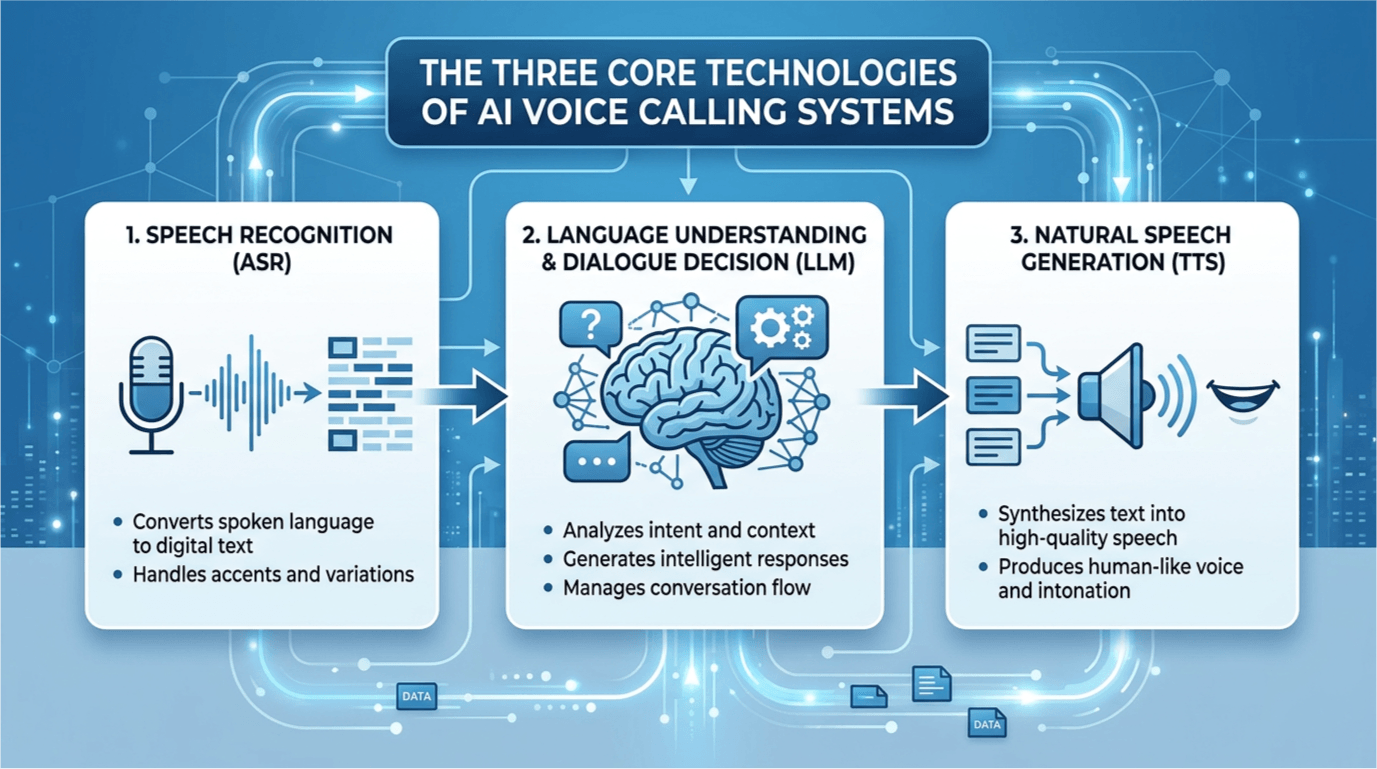
The combination of these three technologies enables AI voice mass calling to achieve more natural interactive communication, significantly enhancing the player experience.
Core Application Scenarios of AI Voice Mass Calling in Gaming
In actual operations, AI voice technology has been widely applied in multiple player communication scenarios
Scenario 1: New Game Promotion and Activity Notification
When a platform launches a new game or a limited-time activity, AI voice mass calling can quickly reach a large number of target players and provide personalized recommendations based on player history.
The system can also judge the level of interest based on player feedback during the call and automatically send follow-up information, such as activity links or reward descriptions, thereby increasing participation rates.
Scenario 2: Player Recall and Activity Enhancement
When the system detects a decline in the activity of high-value players or consecutive non-logins, AI voice mass calling can proactively call for warning and retention. Compared to traditional SMS or email, voice communication can convey richer emotional information, making players feel valued.
In retention dialogues, AI can propose personalized return benefit plans based on player consumption history and game preferences. For example: "We detected that you used to enjoy playing XX game. We have prepared an exclusive return gift package for you, including 450,000 free spins and a 150,000 Rupee cash reward, as well as daily million-Rupee tournaments. Are you interested in coming back to take a look?"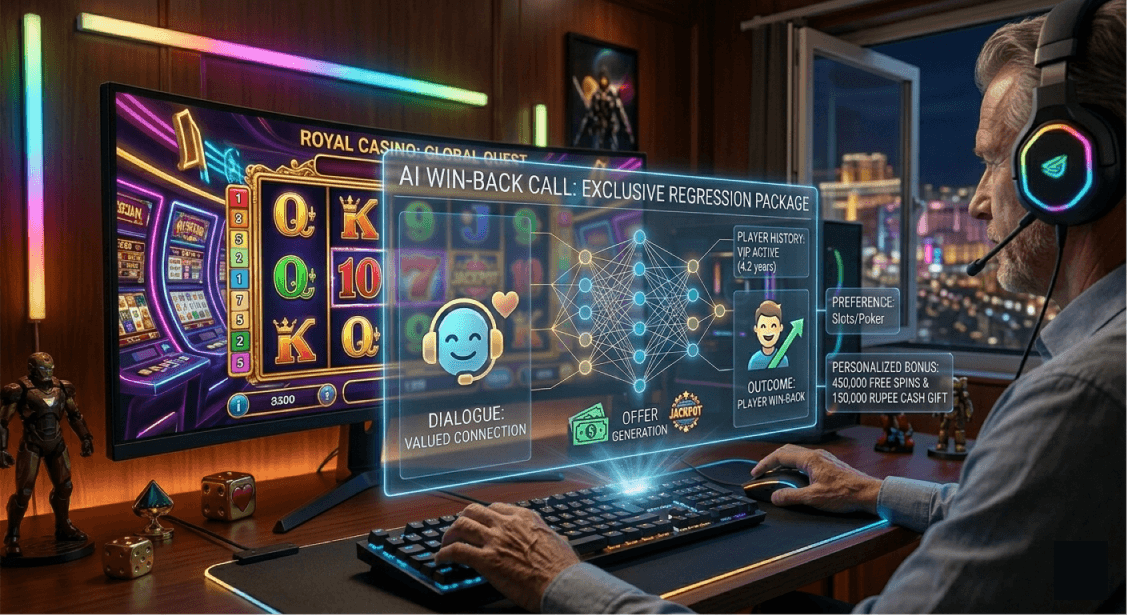
Scenario 3: Player Q&A and Customer Support
By establishing a knowledge base, the AI voice system can answer common questions about top-ups, withdrawals, game rules, etc., and transfer complex issues to manual customer service when necessary.
Scenario 4: Transaction Confirmation and Security Reminders
When large top-ups and withdrawals are involved, AI voice mass calling can immediately call the player after the transaction is triggered to verify identity and transaction intent through multi-turn dialogues, providing risk warnings for suspicious transactions. After the call ends, a hang-up SMS is automatically sent with a transaction summary and security tips, forming a complete security loop.
Comparison of Technical Characteristics of Major Service Providers
Current global major service providers offering AI voice services for the Gaming industry each have their own characteristics:
Twilio has launched AI voice enhancement functions based on its developer ecosystem, supporting large language model integration. However, users need to complete technical development and model training themselves, making it suitable for gaming teams with strong technical capabilities.
MessageBird emphasizes a multi-channel unified API. Its AI voice function is deeply integrated with channels like WhatsApp and SMS, enabling cross-channel synchronization of player interaction data.
Infobip provides industry solution-style AI voice services, with pre-set scenario-based script templates for player recall and activity promotion for the gaming industry, lowering the barrier to entry for gaming companies.
Laaffic, as a leading global SMS and voice service provider, centers its AI voice agent on large language models, deeply integrating local culture and expression habits. It has undergone deep optimization for Portuguese, Spanish, Hindi, Thai, and other languages common in the Gaming industry. According to official data, Laaffic's AI voice system has a semantic recognition accuracy rate of 99%.
AI Voice is Becoming an Important Infrastructure for Player Operations
With the development of communication technology, AI voice mass calling is gradually evolving from a single tool into an important component of intelligent player operation systems.
In the next few years, development trends for AI voice technology in the Gaming industry may include:
Deep Synergy with Cloud Contact Centers
The combination of AI voice mass calling and cloud contact centers can achieve a hybrid model of "AI preliminary screening + manual follow-up." After AI completes intent screening and information collection, high-intent players are seamlessly transferred to manual agents, improving payment conversion efficiency.
Intelligent Application of Hang-up SMS
Personalized hang-up SMS generated based on call content has become a key link in improving conversion rates. The system can automatically match corresponding game recommendations, discount information, or activity links based on the interest points shown by players during the call.
Strategic Services Throughout the User Lifecycle
AI voice can provide differentiated communication at different stages of the player lifecycle, such as new user guidance, activity notifications, and VIP maintenance.
Data Feedback and Strategy Optimization Loop
Advanced AI systems like Laaffic can monitor multi-dimensional data such as outbound call duration, connection rate, hang-up nodes, and customer intent, and automatically optimize scripts and strategies based on data analysis results, forming a virtuous cycle of continuous improvement.
Conclusion
With the acceleration of the globalization process in the gaming industry, efficient cross-regional and multi-language communication has become a core competitiveness for enterprises.
Laaffic is committed to creating an operation system that integrates large-scale outreach and real-time interaction latency through leading AI voice agent technology for gaming companies. We not only help you break through the interruptions of traditional outbound calling but also help you build more emotionally resonant player connections in a volatile market.
Contact the Laaffic expert team now to start your new chapter of AI intelligent operations.